

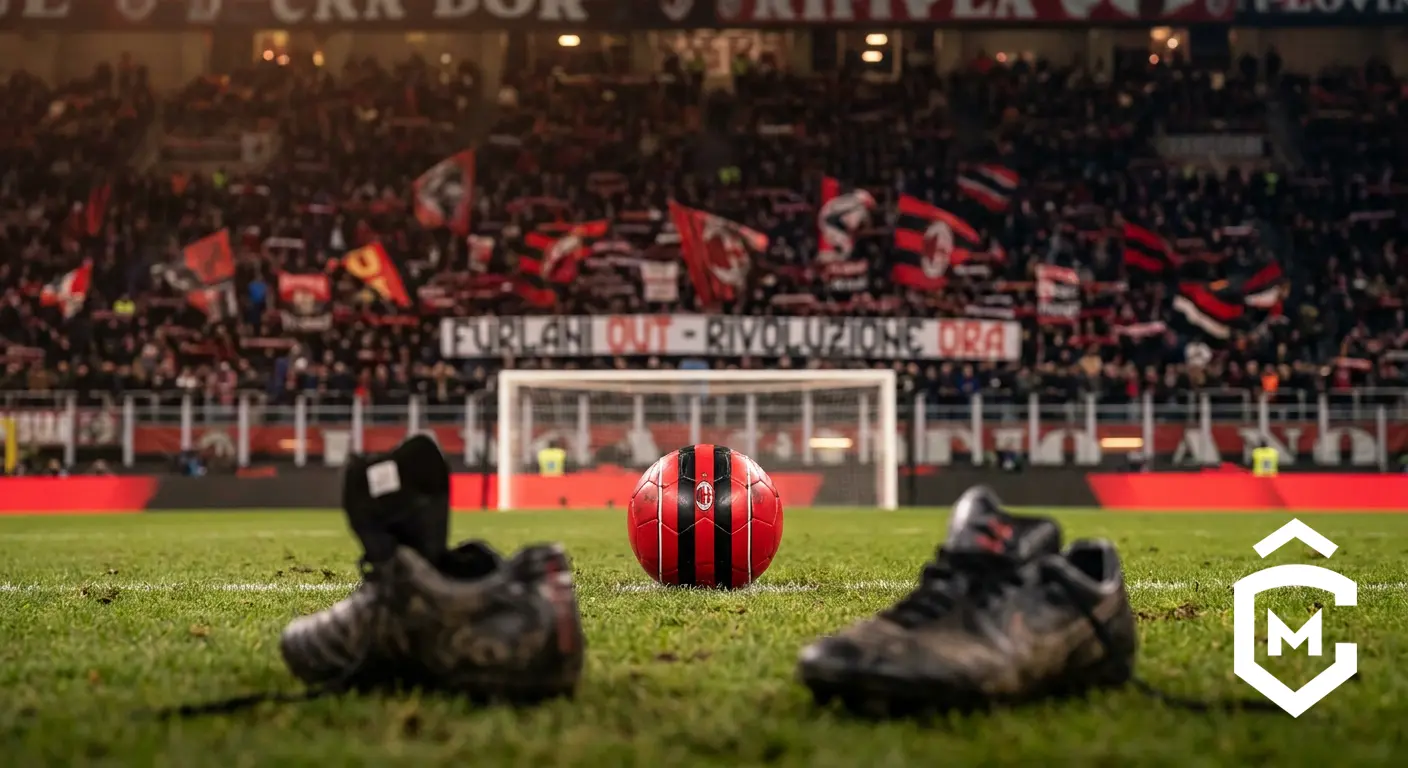
The end of a season, the start of a reckoning
May is the month of verdicts in football. AC Milan have three matches left — against Atalanta, Genoa and Cagliari — to close a season that will have major implications for the club’s European future: Champions League or not. But beyond the immediate sporting result, the time has come to take stock of a cycle that has, unfortunately, produced some sobering numbers.
Four years under Furlani: the sporting verdict is negative
Giorgio Furlani became AC Milan’s CEO in December 2022. As of May 2026, that means nearly four years in charge. Over this period, Milan have finished every Serie A season 15 to 20 points off the top of the table, with a single Italian Super Cup to show for it. For a club of Milan’s stature and ambition, that is simply not enough.
The sporting balance sheet is, objectively, entirely negative. This is not about finger-pointing — it’s about cold, hard facts. Three consecutive positive financial results do signal a degree of economic stability, but they cannot be the sole benchmark for a football club whose DNA is built on winning.
RedBird and Cardinale: the finances are healthy, but what about the fans’ passion?
Jerry Cardinale, Milan’s owner through RedBird Capital, has consistently kept a very low profile: no press conferences, very few public appearances, and a silent management style that might work in any other industry. But football is not just any industry.
Football runs on a unique and irreplaceable fuel: the passion of its supporters. And that passion has shown increasingly visible cracks in recent years. More and more voices within the Rossoneri fanbase speak of fatigue, of growing emotional distance from the club, of a bond that is slowly fraying. This is not a trivial matter: losing the hearts of supporters means losing the very soul of the club.
A truly far-sighted entrepreneur — and Cardinale is widely described as one — understands that financial results and sporting success are not opposites: they can and must go hand in hand. Selling key players — such as Reinders and Theo Hernández — to plug the financial gaps left by missing out on the Champions League is understandable on paper, but it is also a textbook illustration of a vicious cycle that can only be broken through structural intervention.
What the future should look like for AC Milan
The truly great football executive is one who can balance financial sustainability with sporting competitiveness. Keeping the books balanced is not enough: the team must return to fighting for the biggest stages — the Scudetto, the Champions League. Milan is a global club with a legendary history, and its supporters — in Italy and around the world — deserve to dream big again.
The hope is that by the end of the season, sweeping changes at the top of the club will be made, starting with the executive leadership. This is not criticism for its own sake — it is the genuine hope that Milan fans can once again celebrate not just a Super Cup, but the kind of trophies worthy of this club’s great heritage.
The final three league matches will be crucial in determining whether Milan can at least secure a place in next season’s Champions League. But beyond May’s results, it is summer 2026 that could truly mark a turning point for the future of the Rossoneri.