

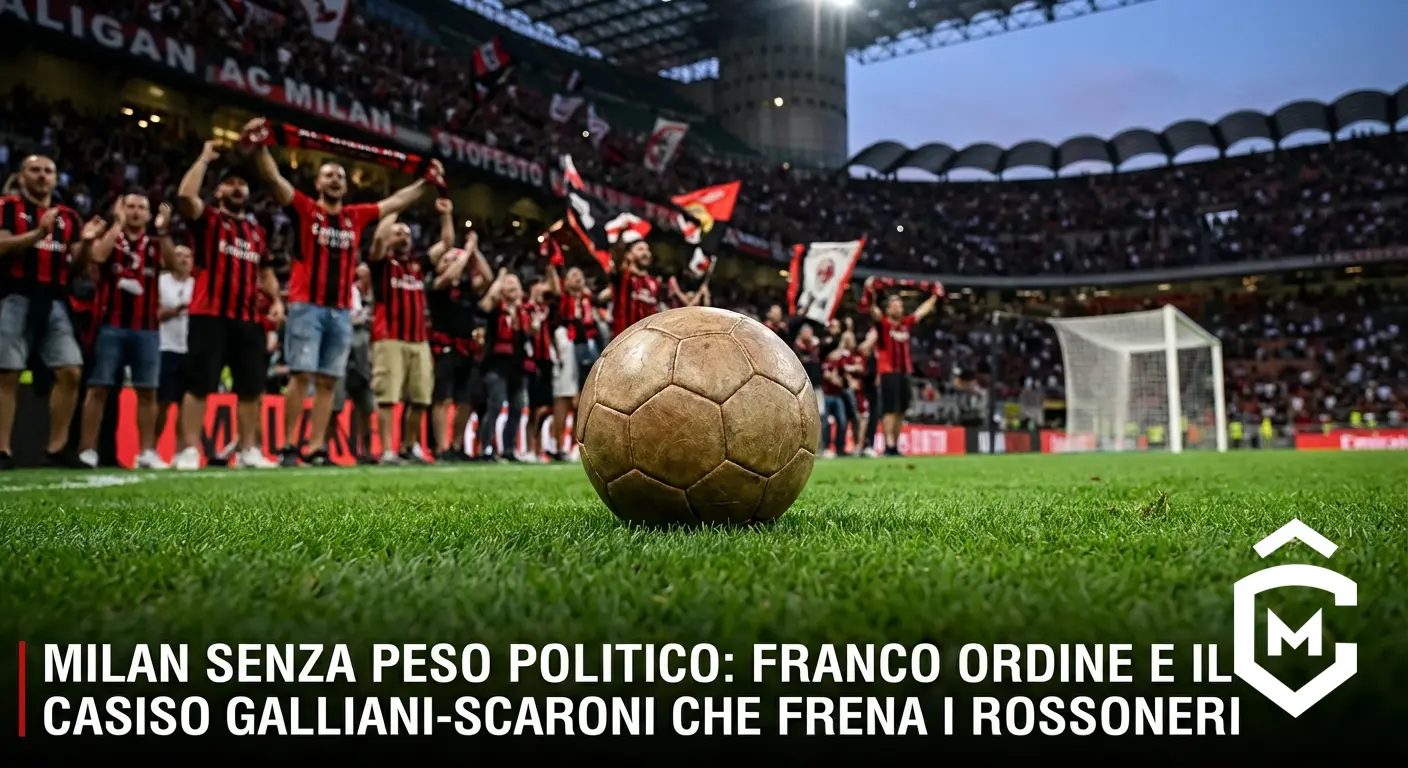
Milan without a voice: the missing political clout
Winning on the pitch is essential, but in modern football, what happens off the field matters just as much — perhaps even more. That’s the core of the editorial signed by Franco Ordine on MilanNews, a sharp and unfiltered reflection on AC Milan’s lack of political influence within the bodies that govern Italian football.
The point is simple but devastating in its clarity: when Serie A’s governing body makes crucial decisions — from referee appointments to fixture scheduling, to the media pressure surrounding key matches — having an authoritative representative can be the difference between being heard and being ignored. And right now, Milan appears to fall firmly in the latter category.
Scaroni vs Marotta: a telling comparison
Ordine draws a comparison that is hard to ignore: on one side stands Beppe Marotta, Inter’s president, a seasoned navigator of Italian football politics, active and influential even at federation level — as evidenced by his candidacy within Italian football’s governing institutions. On the other is Paolo Scaroni, Milan’s chairman, who has publicly stated his desire to “learn” from Marotta.
A statement that, however humble in intent, vividly captures the gap between the two clubs in terms of institutional influence. Starting from a declared position of inferiority, in an environment where power is won through assertiveness, means losing before the game has even begun. Milan has paid the price for this on more than one occasion this season — particularly, as Ordine emphasises, when it comes to refereeing decisions.
The Galliani case: the missed return that could have changed everything
At the heart of the editorial lies a revelation set to spark debate: according to Franco Ordine, Adriano Galliani had wanted to return to Milan, especially after the conclusion of his time at Monza. A comeback that could have restored to the Rossoneri that figure of political gravitas and institutional know-how that is so conspicuously absent today.
But the return never materialised. And the responsibility, according to Ordine, lies squarely with Paolo Scaroni, who allegedly blocked the move for reasons tied to his own position within the club. A chairman protective of his own role who, in the journalist’s reconstruction, feared being overshadowed by a figure of Galliani’s stature and authority.
Galliani, it should be remembered, is not just a football executive: he is one of the few figures in Italy capable of moving with ease through the corridors of sporting politics, sitting at the tables that matter and making himself heard. His absence from Milan, in this regard, weighs heavily.
A structural problem, not just a technical one
What emerges from Ordine’s analysis is that Milan is not facing a simple problem of squad depth or transfer choices: the issue is structural. Without influential political representatives, the Rossoneri risk remaining permanently on the margins of the decisions that shape Italian football — from the appointment of future referee designators to the league’s secretary general and every other institutional lever in between.
The title of Ordine’s editorial on MilanNews is blunt: “If Milan doesn’t count politically, it will always fall behind.” A phrase that serves both as a warning and as an explicit call to the club’s ownership and management to step up on the institutional front, not just the sporting one.
The gap with Inter, Ordine concludes, is not only about points on the table or trophies won: it’s also — and perhaps above all — about the ability to shape the rules of the game. And until that gap is bridged, complaining about referees and fixture lists will achieve very little.