

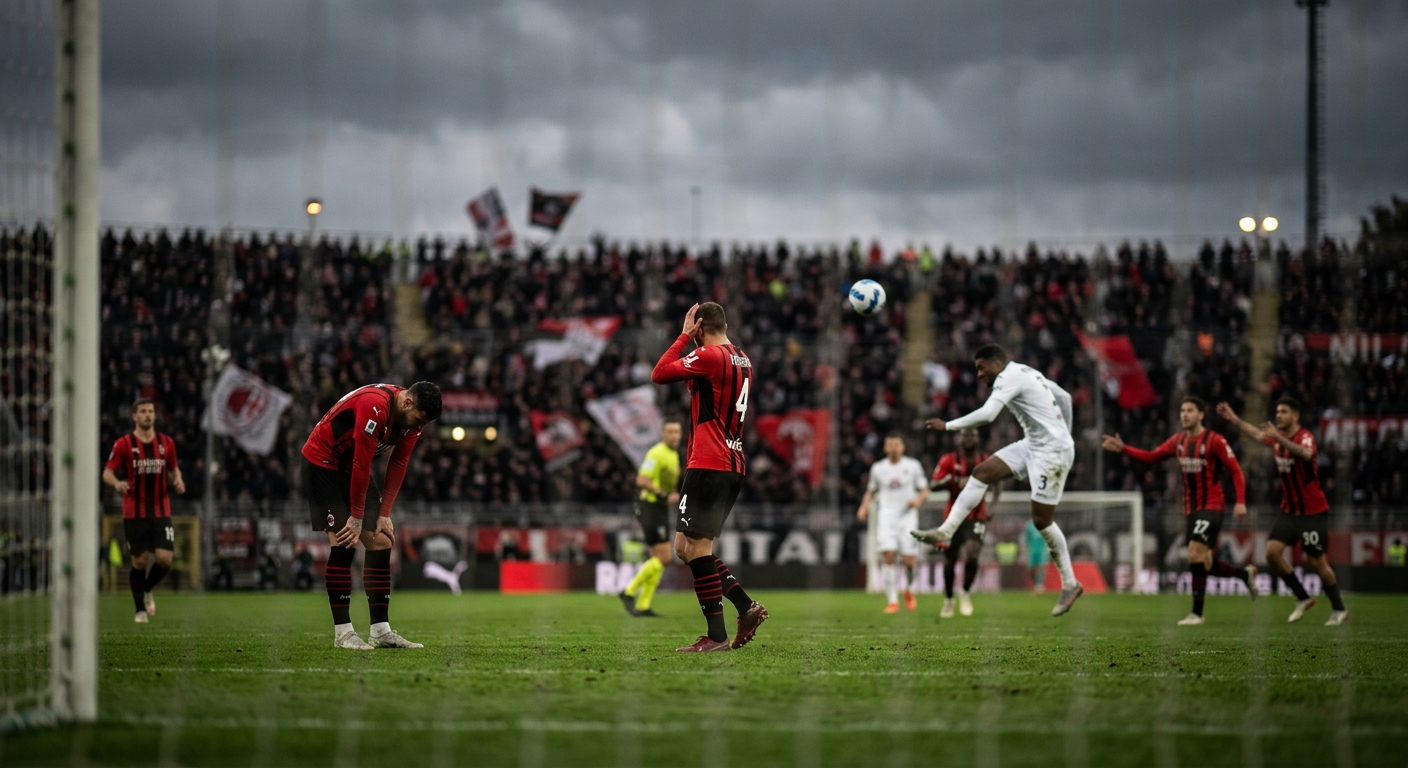
A surrender without excuses. And without even anger. Milan sink at San Siro against Cagliari and Massimiliano Allegri steps up to the microphones with a statement that weighs almost as much as the defeat itself: “I have absolutely nothing to reproach the players for.”
And yet, there is plenty to reproach. Because what was seen against Cagliari was a disjointed, limp, soulless performance. A hollowed-out squad, incapable of reacting, which certified yet another failure of a season born to return to prominence but ending up far from the goals that truly matter. Missing out on Champions League qualification is merely the last snapshot of a disastrous campaign.
The problem goes beyond one sentence
The issue is not just the phrase itself, which has become one of the most overused clichés in modern football. The problem is the context. After such a poor, almost indecorous performance, those words sound to many like a mockery. San Siro grumbled and grew impatient, almost in disbelief at the fragility of a Milan side incapable of even saving face.
Allegri attempted to explain everything with further statements that, however, carry little weight:
- “Unfortunately, when you lose 5 home games, 4 in the second half of the season, we deserved the position we’re in.”
- “If we’ve ended up here, we deserve this standing in the table.”
- “Nobody would have expected a match and a defeat like this.”
- “We’ll need to be very clear-headed in evaluating the entire season.”
- “Certainly, we — and I — made some mistakes.”
Words that are correct in substance, but too late. Because Milan’s problems did not start last night. It is a months-long regression, both technical and mental. And among the heaviest criticisms that can be levelled at the Livorno-born coach is inevitably the management of certain key players.
Leao a ghost, Modric the saviour
Above all, Rafael Leao. The Portuguese winger, a devastating talent and theoretically the poster boy of the Rossoneri project, endured a season as an ordinary player. Never truly dominant, never consistent, often on the emotional fringes of the squad. A technical asset that was never fully unlocked.
Paradoxically, the real engine of Milan was Luka Modric. At nearly forty years of age, the Croatian lit up the game, providing order, rhythm and personality. As long as he had the energy, Milan won and impressed. When his drive ran out, the team switched off with him. A clear sign of a fragile tactical structure, overly reliant on individual brilliance and lacking in offensive alternatives.
A real revolution is needed
And this is precisely where the crux of the season lies: Milan have too often looked like a disorganised, predictable side, incapable of developing modern solutions in the attacking phase. Far too little for a squad that, at least on paper, should have been competing at the highest level.
That is why the club’s rebuilding process cannot be limited to a simple change on the bench. Milan must have the courage to dismantle the current technical management and rebuild a credible, competent football structure that is deeply rooted in the Rossoneri identity. What is needed are figures capable of reading the game before the numbers, men of the pitch and the dressing room. In this light, the return of Paolo Maldini and Frederic Massara would represent not just a romantic choice, but also a decision grounded in competence and continuity with the last successful Milan era.
The overriding feeling is that the failure lies not only in the results, but above all in the lack of identity. And when a manager, after a night like this, claims to have nothing to reproach his players for, the risk is that the gap between reality and perception grows even wider.