

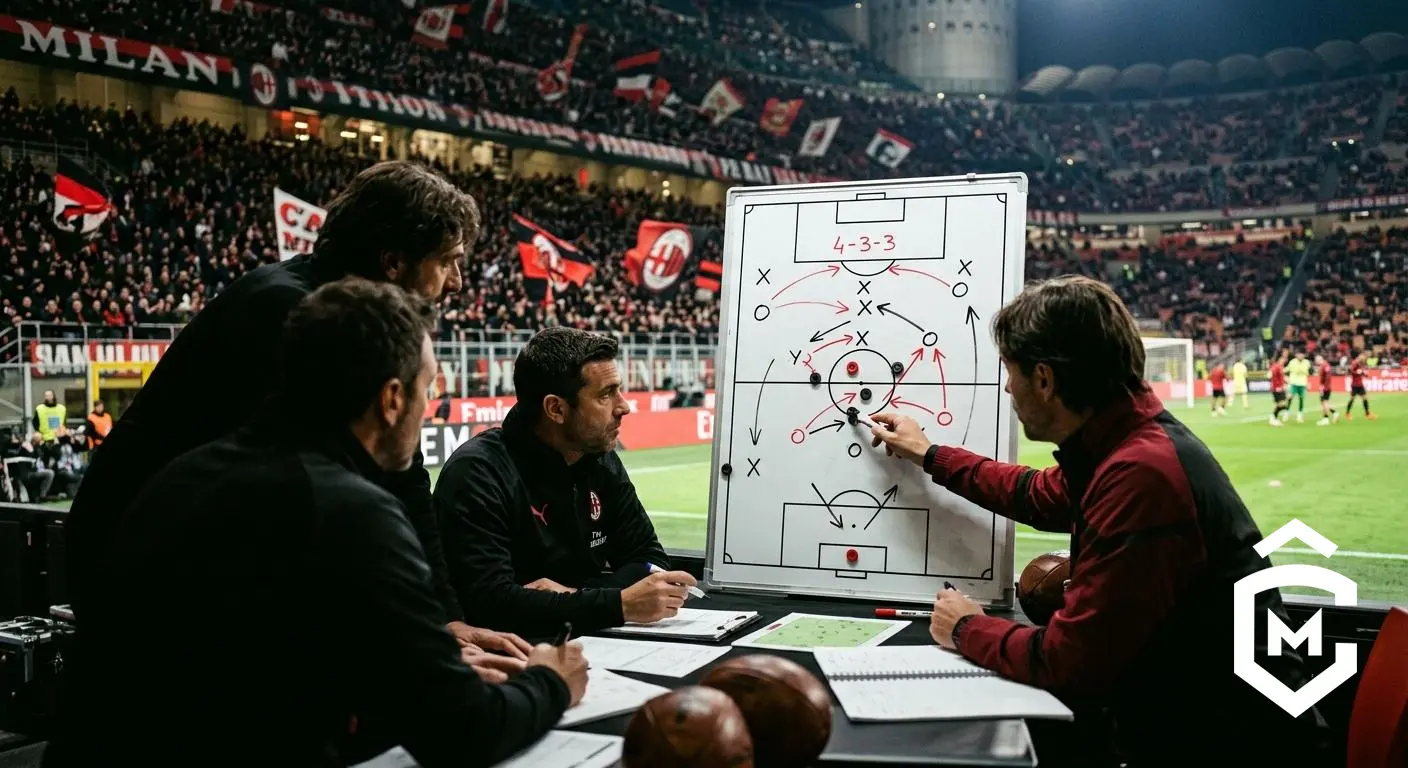
AC Milan enters a new era with a redesigned leadership structure
AC Milan heads into the 2026-27 season with a completely overhauled organisational setup. Following the boardroom reshuffle driven by Gerry Cardinale, the Rossoneri are relying on a technical committee made up of several specialist figures, each with a clearly defined role. The stated goal is to build a modern, data-driven structure geared towards competitiveness. But how does this new model of sporting governance actually work in practice?
Amorim: more than a head coach — a full manager
At the heart of the project stands Rúben Amorim, the new Portuguese head coach expected in Milan at the start of July. His role goes well beyond training sessions and matchday tactics: Amorim is asked to participate actively in transfer market decisions as well. It will be his responsibility to outline the profiles needed, based on his playing system — a 3-4-2-1 formation with two attacking midfielders behind a lone striker, four central midfielders and a back three — and to flag which players could be moved on.
This managerial vision of the head coach’s role is increasingly common across European football, and at Milan it takes on a very structured form.
Almstad and Gardiner: the analytical engine behind the scenes
Amorim’s inputs are then passed to Almstad — Director of Player Trading — and Gardiner — Director of Football Intelligence. These two figures represent the analytical backbone of the entire structure. Through an international scouting network and the use of advanced databases, algorithms and statistical analysis tools, their task is to translate the head coach’s technical requests into a concrete list of viable targets.
The parameters assessed go far beyond technical and tactical qualities, encompassing physical, psychological and economic criteria: a multi-dimensional approach that reflects the most advanced trends in modern football, where decisions are increasingly supported by technology and data intelligence.
Once the shortlist is compiled, Almstad steps in with his operational function: negotiating with agents and other clubs, opening the discussions required to build the squad.
Calvelli, Cardinale and Castelblanco: the financial dimension
No deal can bypass the financial dimension. This is where Massimo Calvelli, the club’s current CEO, comes in. He holds signing authority up to €10 million gross; any operation above that threshold requires approval from president Paolo Scaroni or directly from Gerry Cardinale, the American owner.
Supporting the strategic and financial side is Castelblanco, a long-standing Cardinale collaborator from the world of finance and investment banking, who brings a structured-finance perspective to the committee.
Ibrahimovic: Zlatan still has a final say
And then there is Zlatan Ibrahimovic. The Swedish icon, a point of reference for the entire Rossoneri world, retains an active and formal role within the club: as set out in his contract, Ibrahimovic is required to give his opinion on decisions relating to both the first team and the youth sector. His approval is an integral part of the decision-making process and can concretely influence whether a deal is closed — or not.
An ambitious structure, a challenge to embrace
In total, the technical committee involves at least eight key figures: Amorim, Almstad, Gardiner, the head of scouting, Calvelli, Cardinale, Castelblanco and Ibrahimovic. A model of collective governance designed to cover every angle — technical, analytical, negotiation, financial and strategic — with dedicated specialists.
As recently highlighted in the discussion around AC Milan’s new management structure, this is an unprecedented model for Italian football, inspired by the frameworks used by top English and Northern European clubs. The challenge now is to prove — on the pitch and in the market — that this organisational innovation can truly deliver results. Milan has every tool to make it happen.