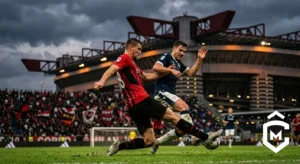



The draw at Sassuolo reopens questions about the Rossoneri’s project. The manager talks of progress and a controlled match, but also admits the team failed to manage the lead. The problem is not just the result: it is the impression of a Milan side that never truly feels in command.
There is a fundamental difference between controlling a match and giving the impression of being able to control it at any moment. It is precisely in this gap — between what Ruben Amorim describes and what his Milan continues to show on the pitch — that the Rossoneri’s contradictions lie. The 1-1 draw against Sassuolo is not just a missed opportunity to claim three points: it is yet another snapshot of a side that alternates moments of decent quality with sudden fragility, never conveying the feeling of having a genuine grip on the game.
After the match, Amorim spoke of a performance in which Milan deserved to take the lead, pointing out that the team had controlled much of the game and managed to limit the opponents’ transitions. Words that paint a partially positive picture, but which ultimately clash with his own admission: “After the goal it’s clear we should have managed the game better, kept more possession and slowed down their reaction.” And also: “We cannot afford to concede goals from corners.”
This is where the conversation gets interesting. If a team truly controls a match, it should be able to absorb the opponent’s reaction without immediately losing its bearings. Milan, however, having taken the lead through Rabiot, failed to turn the goal into a springboard for consolidating their superiority. Odenthal‘s equaliser restored the balance and exposed a fragility that goes beyond marking on set pieces — it concerns the team’s collective ability to read and manage the game’s key moments.
Possession that never becomes dominance
The core issue is not whether Milan had good spells, nor whether they showed the ability to build play and restrict Sassuolo’s initiative at times. The problem is consistency. An ambitious side must be able to turn possession into territorial control, territorial control into chances, and chances into a pressure that suffocates the opposition.
Amorim’s Milan, however, continues to give the impression of being an unfinished team. It does not always impose its own rhythm, does not always find a solution when the first option is blocked, and does not always appear capable of reacting with clarity when the game changes direction. The team’s play can spark into life thanks to individual quality, but it struggles to transmit that sense of overall organisation that sets truly mature sides apart.
Having the ball is not enough to be in command. And taking the lead is not enough to have the game under control. Authentic control is measured above all when opponents increase the pressure, change their approach or find a way to challenge the initial tactical plan. It is in these moments that Milan seems to lose some of its certainties.
The mentality invoked by Amorim
The manager stressed the need to improve, acknowledging the group still has a great deal of work to do. The appeal to mentality is understandable, but risks becoming an overly generic explanation if it is not backed up by precise answers on the tactical side.
A winning mentality, in fact, is not merely a matter of character or concentration. It is also the product of an organisation that allows players to know where to position themselves, which spaces to occupy, how to protect themselves after losing the ball and what solutions to adopt when the opponent’s pressure changes in intensity. An organised team can go through difficult spells without losing its identity, because it has consolidated mechanisms to fall back on.
It is precisely this sense of security that does not emerge clearly enough today. Milan seems to need the match to unfold under specific conditions in order to perform at its best. When the script changes, the team does not always find an immediate and convincing response. As a result, every single episode risks becoming decisive, rather than being absorbed within a system capable of managing the various phases of the game.
The back four doesn’t solve everything
The tactical setup also deserves attention. Amorim explained that the back four gave the players more freedom, after he had seen them too rigid in their positions. This raises another question: if a change in formation is meant to unlock individuals’ qualities, it must still fit within a recognisable organisational framework.
Tactical flexibility is an asset when it allows adaptation to opponents without losing balance. It becomes a problem, however, when the team still appears to be searching for the correct distances, the connections between units and the countermeasures to apply in the most delicate moments.
The question, therefore, is not whether it is better to play with three or four at the back. It is whether Milan can interpret both setups with the same confidence, maintaining compactness, preventive cover and the ability to push up the pitch. The Sassuolo draw offers no reassuring answers on this front.
The problem is consistency, not just the result
Amorim is right when he says an ambitious club cannot be satisfied after dropping two points. But the issue goes beyond the regret of a draw. If Milan genuinely wants to compete for major honours, it must build a game structure capable of holding up even when individual quality fails to make the difference.
A strong team is not one that never faces difficulties. It is one that can navigate them without losing control, change strategy without losing its way and possess more than one solution to reach the desired result. Milan, at least based on what was shown against Sassuolo, does not yet appear to have reached this level of maturity.
The paradox is encapsulated in the manager’s own words: Milan supposedly controlled most of the game, yet needed to manage it better precisely at the moment they had taken the lead. Two statements that, taken together, describe the team’s current limitation. Control exists in patches but never becomes dominance; the lead arrives but doesn’t generate security; organisation is glimpsed but doesn’t yet provide consistent answers.
The season is long, and a draw cannot become a final verdict. Yet matches also serve to measure the gap between ambitions and reality. And Amorim’s Milan, right now, still seems a long way from the solidity that allows a great side to approach every phase of the game knowing exactly what to do.
Because the real step forward is not simply about scoring one more goal. It is about making sure that, after scoring it, it is the opponents who must find a solution. At Sassuolo, the opposite happened: it was Milan who found themselves chasing their own certainties once again.