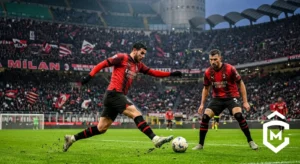



Ramos: two goals, two assists and a mountain of invisible work
Can a striker be decisive without scoring? The question is far from rhetorical, especially when talking about Gonçalo Ramos, the Portuguese centre-forward Milan signed for €73 million — making him the most expensive player in the club’s history. After 11 Serie A matchdays, his personal record reads: two goals and two assists. On paper, that looks modest for such an investment. But the tactical reality is far more complex.
The numbers that never appear on the scoresheet
Focusing solely on goals scored would be reductive. Ramos‘s stats in Serie A paint the picture of a player deeply embedded in Rúben Amorim‘s collective system:
- 1st for interceptions among Serie A forwards
- 1st for ball recoveries among Serie A forwards
- 2nd for receptions
- 2nd for touches
- 3rd for passes
- 2nd for duels
When a striker tops the charts for interceptions and recoveries, the message is clear: he is working for the team before himself. These are not empty words — they are certified figures describing a modern centre-forward who is far from a pure finisher and closer, instead, to a technical and tactical reference point for the attacking line.
The Genoa match: Ramos as the silent key to both goals
The clearest example comes from Milan’s last victory against Genoa, which ended 2-1. In both Rossoneri goals, the Portuguese striker played a central role — without appearing among the scorers.
In the first goal — scored by Alexis Saelemaekers — Ramos attacks depth, drawing the defensive marker and freeing the Belgian winger to receive Adrien Rabiot‘s precise pass. The striker’s run is the mechanism that triggers the entire move.
In the second goal — signed by Christian Pulisic — Ramos recovers a lost ball and, rather than shooting from a suboptimal position, plays a no-look pass to the American, better placed to finish. A pure display of footballing intelligence: Ramos assist, 2-0 Milan.
A selfish striker, in that situation, would probably have shot. Ramos, instead, reads the game and makes the right call for Milan.
The comparison with Pulisic, Saelemaekers and Rabiot
It must be acknowledged that, in terms of goals, the Portuguese striker lags behind teammates such as Pulisic, Saelemaekers and Rabiot, each of whom has between four and five league goals. A significant gap. However, looking at the team’s overall performance across 11 matchdays, it is clear that Ramos’s movement is often the enabling condition for his teammates’ goals.
Rúben Amorim himself has publicly praised this quality in his number nine: «He sacrifices himself for the team», the Portuguese manager stated, while also issuing an important reminder — Milan must also learn to work for Ramos, not only with him.
Chukwueze’s absence and its tactical impact
A key factor in Ramos’s offensive output is the absence of Samuel Chukwueze, who underwent surgery in London and is sidelined for at least three months. The Nigerian winger, deployed by Amorim as a right-sided attacker, provided pace, dribbling and low crosses — exactly the kind of delivery that suits Ramos’s movement inside the box.
Without Chukwueze, Milan has adapted to a more vertical and central style of play, with the runs of offensive midfielders like Rabiot and Pulisic making the difference. This has inevitably changed how Ramos receives the ball, often pushing him outside the area to drop deep and participate in build-up play — closer to a second striker than a classic centre-forward.
Waiting for the goals: the weight of the investment
€73 million. The price tag is impossible to ignore. The investment carries enormous expectations, and two goals in eleven matches do not yet meet them. Football is made of goals, and goals win games. The invisible work is precious, but it cannot be a striker’s only contribution.
Milan and Amorim know this well. And Ramos almost certainly does too. His talent is beyond question, the system is still finding its balance, and Chukwueze’s eventual return could be the turning point that finally unlocks the full potential of Milan’s Portuguese centre-forward.